

Steel Parallel Lifting Beam / Equalizing Spreader Beam
Steel Parallel Lifting Beam / Equalizing Spreader Beam
Prefabricated Construction Core Lifting Equipment Product Brochure
1. Product Introduction
The Steel Parallel Lifting Beam (also known as Equalizing Spreader Beam, Balance Beam, or Load‑Distributing Beam) is an indispensable core lifting device in the production, installation, and transfer of precast concrete (PC) components within the prefabricated construction industry. Manufactured from high‑strength structural steel (Q235B / Q345B / Q390B) via CNC cutting, precision welding, stress relief, machining, and surface treatment, it is engineered per the component's geometry, dimensions, self‑weight, and lifting load to deliver a balanced multi‑point lifting scheme—ensuring uniform force distribution, stable posture, no deformation, and no overturning during hoisting.
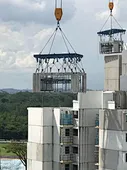
In industrial prefab operations, one (or both) ends of the beam connect to lifting equipment—tower crane, mobile crane, overhead crane—via hook/shackle, while the other end connects to the precast element (wall panel, slab, staircase, balcony, bay window, modular unit) via slings, shackles, vacuum suction cups, or dedicated lifting devices. By converting a single‑point lifting force into evenly distributed multi‑point loading, it significantly reduces local stress concentration, making it a critical piece of equipment across the full"tilt‑up → lift → transfer → positioning"workflow.
2. Product Parameters & Specifications
| Parameter Category | Typical Spec. / Range | Description |
|---|---|---|
| Product Type | Parallel Lifting Beam / Equalizing Spreader / H‑Beam Lifter | Per component & duty |
| WLL (Working Load Limit) | 5 t / 10 t / 20 t / 30 t / 50 t; custom up to 100 t+ | Incl. dynamic factor 1.1–1.3 |
| Span / Effective Length | 2 m – 12 m (custom per component width) | Lifting points adjustable |
| Main Beam Section | I‑beam / H‑beam / Welded Box Beam | Per FEA verification |
| Material | Q235B / Q345B / Q390B / 16MnDR (low‑temp) | Std. / Heavy / Low‑temp |
| Plate Thickness (Lug/Web) | Lug 20–40 mm; Web 10–25 mm | Per stress calculation |
| No. of Lifting Points | 2 / 3 / 4 points (equalized) | Adjustable trolley optional |
| Top Connection | Hook / Shackle / Swivel Ring / Direct Pin | Matches crane hook |
| Bottom Connection | Shackle + sling / Vacuum cup / Dedicated gripper | Per component type |
| Surface Treatment | Sa2.5 blasting + Zinc‑rich epoxy + topcoat / HDG | Anti‑corrosion per env. |
| Safety Factor | Static ≥4× WLL; Dynamic ≥2× WLL | Per ASME B30.20 / EN 13155 |
| Self Weight | 0.5 t – 8 t (per spec.) | — |
| Applicable Standards | ASME B30.20, EN 13155, GB/T 25852 | Intl. / GB optional |
3. Product Usage Instructions
- Pre‑Lift Inspection: Verify WLL ≥ component self‑weight × dynamic factor (1.1–1.3); inspect lugs, welds, shackles, and slings for cracks, deformation or wear; confirm crane rated capacity matches working condition.
- Hook‑up: Securely connect the crane hook to the beam's top lifting point, ensure shackle pin locked and cotter pin in place. Arrange bottom slings and shackles symmetrically according to component center of gravity (CG), sling included angle α≤60°.
- Trial Lift: Hoist approx. 200 mm and pause, check component balance, even sling tension and no slippage. Lower load immediately and readjust lifting‑point spacing if eccentric loading occurs.
- Formal Lifting & Transfer: Operate under unified command of certified signaler; keep hoisting and braking smooth. Skew‑lifting, side‑pulling and overloading are strictly prohibited; no personnel shall stay beneath suspended load. In‑plant transfer speed shall be limited to 5‑10 km/h.
- Positioning & Detackling: Remove bottom slings and top hook only after component is set and temporarily secured; detackling before component stabilization is forbidden.
- Routine Maintenance: Inspect lugs, welds and shackles each shift; lubricate pins and rotating parts monthly. Maintain usage log and perform full NDT flaw‑detection inspection every 12 months or every 200 lift cycles.
4. Application Scenarios
- Precast Wall Panel Tilt‑up / Lifting: Tilting flat‑stacked shear and cladding panels to vertical posture; multi‑point equalized loading prevents concrete cracking.
- Composite / Hollow‑Core Slabs: Four‑point lifting for large‑area slabs, avoid surface cracks caused by single‑point stress concentration.
- Stairs / Balconies / Bay Windows: Balanced hoisting for irregular and eccentric precast components by adjusting lifting‑point positions.
- Modular Building Units: Horizontal and vertical transfer for volumetric modules such as integrated bathroom units.
- In‑Plant PC Component Transfer: Cooperate with overhead crane to transport heavy precast elements among production lines, curing kilns and storage yards.
- Bridge / Rail Transit Segments: Lifting and tilting operations for bridge segments, track slabs and tunnel segments.
- Steel Structure / Mold Transfer: Inter‑process hoisting for large steel assemblies and precast mold bases.
5. Safety Precautions
5.1 Load & Lifting Safety
- Never exceed rated WLL; eccentric load cases shall be re‑verified by structural or lifting engineer.
- Sling‑to‑vertical included angle α≤60°, larger angle will generate higher tension force on slings.
- Crane rated capacity must be greater than total weight summing beam self‑weight, component weight and rigging weight.
- Skew‑lifting, side‑pull and sudden braking are forbidden; never use lifting beam as welding return circuit or earthing point.
5.2 On‑site & Environmental Safety
- Set warning zone and assign certified signaler; personnel are strictly prohibited under suspended load or swing range.
- Suspend open‑air lifting work under Beaufort 6 wind (≥10.8 m/s); hoisting is not allowed during thunderstorm or heavy fog.
- Periodically inspect lugs and welds every 12 months or 200 lifting cycles; stop usage once cracks or deformation are found.
5.3 Rigging & Personal Protection
- Confirm matching rated load for pins and shackles before use; keep pin locked with cotter pin in position; welding repair on shackles is prohibited.
- Operators shall wear safety helmet, safety boots and high‑visibility vest; adopt radio communication or standard hand signals for hoisting command.
6. OEM & ODM Customization Services
We provide comprehensive customization services to meet global clients’ diverse needs:
- Size Customization: Custom span 2‑12 m, quantity and spacing of lifting points, beam depth and section dimension according to component geometry and production‑line layout.
- Load Customization: WLL ranging from 5 t up to 100 t+, complete with dynamic, fatigue and stability calculation verification.
- Material Customization: Optional Q345B, Q390B, 16MnDR for ‑40℃ low‑temperature condition, stainless‑steel cladding for heavy‑corrosion environment.
- Structure Type: I‑beam, H‑beam, box beam or truss‑style for weight reduction on long‑span applications.
- Lifting‑Point Mechanism: Fixed lifting points, adjustable trolley points, swivel rings or quick‑release hook devices for selection.
- Connection Interface: Top side supports hook, shackle or direct pin connection; bottom side compatible with shackle‑sling assembly, vacuum cup or dedicated mechanical gripper.
- Surface Treatment: Epoxy coating, HDG hot‑dip galvanizing, RAL‑color powder coating and Dacromet treatment for various anti‑corrosion demands.
- Function Integration: Load‑cell interface, RFID component tracking module, anti‑sway device and remote‑controlled quick‑detach hook are available.
- Branding & Packaging: Laser‑engrave client logo, WLL nameplate, serial number and safety warning marks. Export‑grade anti‑rust packing with fumigation‑free wooden crate and container‑optimized loading scheme.
7. Why Choose Us?
- Industry Expertise: 10+‑year R&D and manufacturing experience for steel lifting equipment and precast molds, products delivered to more than 20 countries worldwide.
- Design Capability: In‑house structural, BIM and CAD engineering team with FEA finite‑element verification to guarantee loading safety and dimensional precision.
- Precision Manufacturing: Equipped with in‑house CNC machining center, large gantry milling machine and automatic welding equipment, stable weld quality and controllable key dimensions.
- Quality System: ISO 9001‑certified; every lifting beam undergoes static‑dynamic load simulation, full dimensional inspection and weld NDT flaw‑detection before shipment.
- International Compliance: Well‑versed with ASME B30.20, EN 13155, CE and other international standards; multilingual technical documentation is available.
- Service Response: 7×24‑hour technical support, 48‑hour after‑sales response; on‑site installation guidance and operator training services can be provided.